Purpose

This is a blog containing the build history of an experimental home built airplane. The RV-7A is a two place, piston powered, low wing, tractor configuration, tricycle gear, aluminum and composite aircraft. The original purpose of this blog was to document the construction of my experimental category aircraft in order to satisfy the build log requirement for the FAA. Now it's just for the amusement of friends and family as I document some of our aviation experiences. For more information on the RV series of aircraft see www.vansaircraft.com.

Monday, April 3, 2017

750nm day trip


Our plan was to depart at 9:00am. Sharp. No kidding, 9:00am. Really, that's when we're leaving.  Needless to say, that didn't happen. Neither did 9:30am. If we can send a man to the moon... How come we can't leave on time? OK, that's a bit of a non sequitur, but it's a good thing because if a man's moon trip actually depended on us leaving on time... He won't be going.
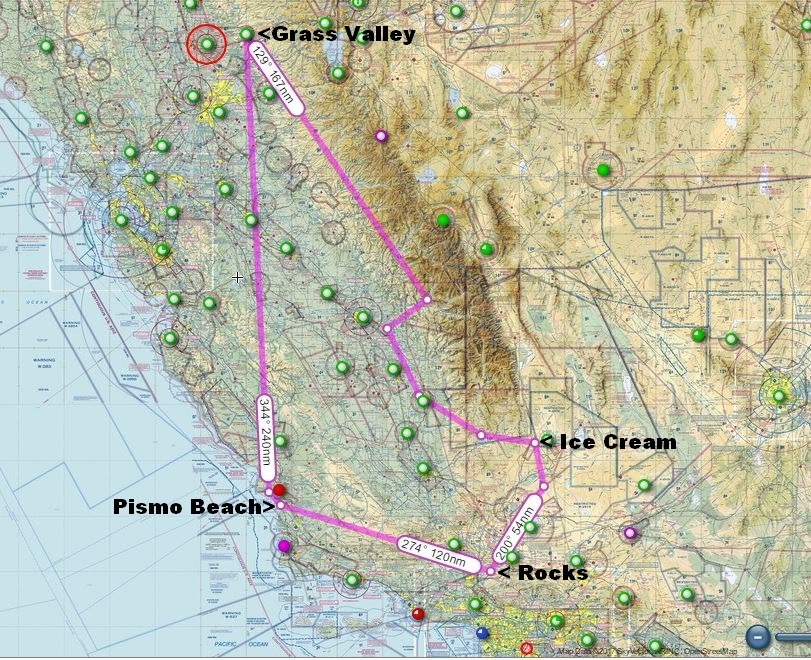
Eventually, we did depart, obviously. The wheels left Terra firma at 9:45am.  Why the big rush? Because we were going to get some ice cream -- 313 miles away.  The destination was actually Inyokern airport and on this day it was the location of Axel Alvarez's 9th annual ice cream social. And since we were committing a day to it, why not travel around Southern California a bit?


Our initial route had us on a southeasterly heading.  Cruising about 5500' we had a beautiful view of the western slopes of the Sierra Nevada mountain range that I had intended to follow pretty much all the way to Inyokern.  About 45 minutes into the flight we were treated to this view of the entrance of the Yosemite valley.


The view off to the west was not so inviting.  But why should I care?  We weren't going over there. Or were we?  It was about this time that I was informed of an issue in the passenger cabin.  It seems that one of the passengers needed to use the facilities.  Not a problem in an airliner, but in our two place airplane the nearest facilities were miles away.  26 miles in this particular case.  The Garmin avionics make quick work of spelling out one's diversion options. Reedley airport was about the closest, but I wasn't sure if we could get down through the cloud layer once we got there.  It turns out that Reedley was not overcast, just a broken layer and some mist to get through.  Once we got close we could see the airport without difficulty from a few miles out. 

Reedley was typical of the small airports that dot the Sacramento valley.  Surrounded by farmland on this lazy Saturday morning, Reedley was quiet and very nearly deserted. By comparison, Fresno, just a few miles to the northwest, is a bustling metropolis.  Fortunately, there were facilities available. They were clean, and we were grateful.  I spent a bit of time looking at my charts and just soaking in the quietness.  I was hoping that by delaying our departure, the cloud layer above would dissipate.   Here is a view to the southwest over the valley. Reedley is down there somewhere.

After some time it was apparent that the broken cloud layer wasn't going to clear up any time soon, so we decided to depart south towards Porterville staying just below the cloud layer.  My plan was to get us closer to the ice cream and look for clearing weather.  Fifteen minutes later we're at Porterville and the cloud layer is not looking any better.   Time to turn left and head in an easterly direction towards Inyokern.  As a VFR pilot, I am not allowed to fly through the clouds. In this situation, I must find a hole in the cloud layer to fly through.  Since the sky was not completely overcast and it wasn't too difficult to find such a hole. 

Isabella Lake, Kern Valley CA
Presently, the clouds below give way to granite tipped mountains, our last barrier to ice cream.  The RV-7A easily out climbs the rising slopes and we find ourselves crossing the Sierras at 9500 feet. Passing just north of Kern Valley airport we begin a slow descent that takes us south of Walker Pass at 5200' and then all the way down to the desert floor at Inyokern.

When we arrived the ice cream social was in full swing.  There were about 20 RV aircraft already there and more arrived after us.  We took the last parking space in the front row.  The warm desert air was absolutely balmy, a welcome change from the cool dampness we left behind in Grass Valley.  Our location at the end of the line granted the opportunity to see some really nice aircraft as we strolled the tarmac toward the gathered crowd.  

At the terminal, several flavors of ice cream and all the fixings for cones and sundaes wait for us at the end of a short line.  I had a bowl of vanilla and then I added some sprinkles on top just because I'm a wild man. Carol opted for a cupcake.

We milled about for a bit just watching the people happily chatting in various groups of three or four.  In every direction, pilot's speak is overheard.  The pilot's spoken language is two thirds English and one third acronym. On the ground, it is also partly visual.  It is not hard at all to spot the right hand-as-airplane gestures that describe their airplane's curving path through the sky.  And should a second plane enter the story, the left hand is ready and willing to fly as well.  This is what pilots do when they are on the ground.


And so, once again, I failed to take enough photos to tell any kind of reasonable story.  Here is the parking area with my plane at the far end, not visible, and too small to be seen in this shot anyway.


After about an hour or so of mingling, we thought it best to seek out our host, Alex, to thank him and his wife Alisha, for their hospitality and all the effort that goes into organizing something like this.  It was still early in the afternoon, but there was still a lot of ground to cover.  So we quickly refueled and we were on our way.

Our next destination was Vasquez rocks which Carol and I had visited by automobile in 2014.  We thought it would be fun to see by air and it was.  Unfortunately, I can't show you what it looked like because our camera was just out of reach in the baggage compartment.  Alternately, both of us tried to reach the camera as I circled over the rocks all to no avail.  It was awesome though, really it was.

The flight from Inyokern and Vasquez rocks was about 200 miles and allowed us to overfly Mojave airport, the birthplace of Spaceship 1 and 2. Our next stop was Pismo beach where we planned to walk the quiet sands and listen to the sounds of seagulls and the crashing surf.  The reality turned out a bit different. 

We landed at Oceano airport after a brief delay for skydivers.  The Oceano airport is only about a block from the beach.


But first, we needed to get some food.  As we were leaving the airport we happened across a gentleman who suggested several restaurants that were close by.  We selected the Rock & Roll cafe which had been constructed out of two railroad cars.  It had a 50's motif that seemed to fit and the food was very tasty.  


It was only after we had thoroughly enjoyed our lunch and were on our way out, that I saw a mouse run by under the table next to me.  I guess the mice know a good place too.

After our rather late lunch, we walked two blocks south to the ocean.  It turns out that Pismo beach allows vehicle traffic to drive onto the beach.  In addition, there were a variety of off road vehicles taking advantage of sand dunes a little further south.  Our quiet walk on the beach will have to wait for a different venue.


After we had our fill of the ocean (which didn't take too long), we started back for the airport.  At the entrance to the beach, there was assembled a great line of pickup trucks, mostly Chevys, waiting to gain access.  It seems that this beach is also a cruising destination.  It was Saturday night, after all.


Oceano Airport.

With the lengthening afternoon shadows, we turned our attention home still some 250 nautical miles distant.  We blasted straight out of Oceano, flying the runway centerline out over Morro Bay and around the west side of San Luis Obispo Airport's airspace.  Then we turned our little plane northeast for Grass Valley.  To clear the coastal range, we made a comfortable climb to 7500'.  Leaving the mountains behind and still cruising at 7500', I tuned in Nevada County Airport.  It surprised me that still 175nm away I could hear an aircraft happily traversing our home airport's traffic pattern.  The thought occurred to me to announce a 175 mile 45 for left downwind 25, but I just let it remain my little joke.

The sunset as we were just south of Sacramento, but in the fading light, I was able to capture this last photo.  Folsom Lake in the foreground, Sacramento and the mostly flooded valley floor behind it, and finally, the coastal mountains in the far distance.


750 nautical miles flown, ice cream, rocks, lunch, a mouse, the ocean, and many great views of California.  A great day.

Tuesday, March 14, 2017

Upgrades!

As luck would have it, I completed my phase 1 testing just in time for a record breaking stint of bad weather in Northern California.  So, I have been using much of my weather induced free time for airplane maintenance and some upgrades.  

First, I added a vacuum crankcase ventilator and oil separator.  The pair sound much more sophisticated than they actually are.  The engine's crankcase is normally vented to the outside air stream which serves to prevent pressure from building within the crankcase, but at the same time, it allows some oil vapor in that air to escape the engine.  This has the unfortunate consequence of depositing an oily film on the belly of the aircraft and, obviously, increasing oil consumption.  The oil separator reduces this issue by condensing the oil out of the crankcase gases before they leave the aircraft. The collected oil is then allowed to drain back into the engine.  The vacuum ventilator aids this process by pulling a vacuum on the crankcase vent by virtue of venturi action.  The vacuum ventilator directs the crankcase gases into one of the exhaust pipes rather than just overboard.  I've got a few hours on the system now and it definitely does help keep the aircraft bottom clean.

Another upgrade involved adding an additional GPS radio receiver.  This new GPS radio is connected directly to my transponder, feeding it position and velocity data.  This GPS radio is different from the other 3 GPS receivers in my plane in that it meets the FAA's 2020 requirements for Automatic Dependent Surveillance (B) accuracy.  I am now 100% compliant having already installed a compliant transponder.

For those not aware, the FAA has a grand plan to overhaul the air traffic control system called NextGen.  A major part of this new system is ADS-B which works primarily with GPS rather than radar.  To get this system off the ground, so to speak, the FAA has mandated that all aircraft (with electrical systems or those not otherwise exempted) be equipped with new transponders for relaying the ADS-B data and GPS receivers capable of achieving a high level of precision and accuracy in reporting their aircraft's position. Those not upgrading to ADS-B will not be allowed into certain controlled airspace.

And as the rain continued, I decided to upgrade my audio panel as well. I removed my practically new Garmin GMA-240 and replaced it with the clearly superior GMA-245.  What did I get for the extra five?  The new panel has Bluetooth so it can pair with my cell phone or with my Garmin VIRB camera.  In addition, it also has several new audio modes including splitting the COMS between pilot and copilot.  It also sports 3D audio which I believe means it can place certain audio sources in different places spatially. The justification for the new audio panel is that it is new and therefore I need it.

And so spring is fast approaching and I expect to resume flying with renewed vigor and some new equipment.  Sorry, no pictures this time.


Friday, October 14, 2016

Step 14.7, First passenger


Now that my forty hour long phase 1 survey of the Sacramento valley is complete, I can carry passengers and go just about anywhere.  And, as luck would have it, my wife and aircraft building partner likes to go just about anywhere.  Thus, it is fitting that she should be my very first passenger after putting so much time into this project.  The idea that she would be my copilot and aerial companion was ever present on my mind through the many long hours of construction.  If reality follows the plan, then many high flying adventures await.

The light wing loading and short span of the RV series aircraft are key to the airplane's legendary agility.  That the airplane is so light and nimble is a great quality for the pilot flying for sport, but for the passenger, especially an inexperienced passenger, it can seem unstable.  With this in mind, I was really hoping for some great weather and smooth air for our first trip.

But where to go?  I wanted the trip to be relatively short and avoid the heat of the summertime Sacramento valley.  I selected Half Moon Bay because there are a number of restaurants within walking distance of the airport and the scenery along the route is quite impressive.

Ascending from Nevada County airport the Sierra foothills quickly give way to the expansive Sacramento valley.  Our south-westerly course then enters the bay area between Vallejo and Concord, passing over the Carquinez strait and finally across the San Pablo Bay.  The route continues past Tiburon and Angel Island and then out over the Golden Gate bridge.  At this point, a left turn is the only thing keeping you from going to Hawaii (and a lot of fuel).  After turning south, following the beach leads to Half Moon Bay.  It's about 130 miles by air with the route shown.  By car, it's 175 miles. Much better to follow the crow.


The first step was getting Carol into and comfortable in the airplane.  The seat belts needed a bit of adjusting having only held sandbags since their installation.  Once Carol was in I did my preflight and then joined her in the cockpit.

The first leg of our journey lasted only a few minutes it takes to taxi down to the fuel pump. Once fueled, we first taxi back the way we came and then out to the runway run up area.  It can be pretty hot under the bubble canopy, so the run up checks were conducted post haste.  I usually like to take time to explain the purpose of each check to my passengers that are new to general aviation, but Carol has flown with me before, and as I mentioned it was pretty hot.


The wind was blowing about 8Kts to 10Kts which is not too windy, but it is enough to create some turbulence especially on such a warm day.  Just before we took the runway, I mentioned this to Carol so that she would have an idea what to expect as we climb out of Nevada County airport.  

One last check: Mixture rich, flaps 10 degrees, prop high.  "Nevada County traffic, experimental niner Romeo Victor is departing 25 straight out", I announce over the common traffic advisory frequency. Throttle forward to the max and we begin rolling.  Vr at 60Kts, positive climb established. Retract the flaps and we are on our way.

We climb up to 6500 feet and head southwest.  Our route takes us over the top of Sacramento Metro airport's class C airspace.  In the distance, Mt. Diablo looms, and in the foreground, the Sacramento river delta points the way west.  Soon we are passing over the top of Travis Air Force Base and on the horizon, I can just see the Golden Gate Bridge.  The visibility was in excess of 40 miles which is pretty good for this time of year.

The air at the cruising altitude was less bumpy and I am relieved to see Carol relax a bit.  I begin to explain the operation of the autopilot which I had enabled as soon as we were established in the climb.  "Watch this Carol", I said with some excitement. "The plane is going to level itself off at our cruising altitude."  I don't think Carol was quite as impressed with the autopilot as I am, but that did not crush my enthusiasm.  "Now look how I can turn the plane with just this knob."  I was beaming.

"Can't you just push on the stick and do the same thing?", she asks.

"Well, yes", I admit, a bit deflated, "but that is not the point."  And so it goes.  I then move on to explaining the symbology of the traffic scope which allows us to see other aircraft in the area just like an air traffic controller.  Interspersed the avionics seminar I was conducting, I was pointing out the various landmarks and cities below.

About the time we cross over the Carquinez straight I begin letting down so as to avoid entering the San Francisco class B Airspace.  As we get lower we begin to get buffeted by some mild convective turbulence.  After resetting the radios to Nor Cal approach frequency and then to Half Moon bay, I am mostly just watching for traffic and enjoying the view.  There is fog offshore and I just hope it stays there. 


We cross the Golden Gate at 1400 feet which is about twice as high as the bridge's towers are tall. The bridge is so big though, that it gives me the illusion that I am not high enough to clear it until I am very close.  I've flown over the bridge several times in the past and I've had this uncomfortable feeling each time.  I check and double check my altitude. It doesn't help that the air is getting a little bumpier here and we are lurching about.  There are a number of other aircraft in the area and I am dividing my attention between the bridge and watching the traffic on the scope.  

Once we clear the bridge we turn south we follow the beach passing the Cliff House and Golden Gate Park on our left.  Then comes the town of Pacifica, and finally we arrive at Half Moon Bay.  The fog is holding about a mile or so just offshore and there are other aircraft between us and it watching whales, so we have to be extra vigilant.  The wind is blowing 14Kts, but is aligned with runway 30 and is not a factor.

On landing, we taxi to the south end of the airport where there are tie downs for people wanting to walk into the city of Half Moon Bay.  These tie downs are separate from the airport's main transient parking area and, as I said, they are at the extreme south end of the airport.


This is where I have to apologize to the reader for not taking many pictures on this trip.  It seems this post will be mainly about our flight down because I only had two usable pictures from Half Moon Bay itself.

There is a short path next to the tie downs that lead to an area with several restaurants, a couple of bars, and a brewpub that was fairly busy.  I really want to get back to the brewpub, Half Moon Bay Brewing Company, sometime when I'm not flying.  


There is also some kind of shopping area and a nice looking hotel right next to the water. We didn't spend a lot of time exploring Half Moon Bay because I was worried that the fog might come in.  But we did select a place to have lunch called Old Princeton Landing.


The lunch was good and the view out over the bay was nice and there was even a friendly dog sitting on the sidewalk next to the front door.  Initially, we thought the dog belonged to a couple that was eating at the table next to us, but when they left the dog stayed.  Later we found out the dog belonged to someone working inside.

After lunch we made a quick walk down to the pier and then retreated to the airport.  The flight back was uneventful except for a quick stop at Nut Tree in Vacaville.  The oil filler door popped open (again).  It doesn't do any damage to be open other than the aesthetic damage to my view, but after a few minutes of staring at it through the canopy, I gave in and decided to land. The wind at Nut Tree was blowing 18Kts, but once again it was right down the runway and presented no difficulty.

Open Oil filler door

We enjoyed the strong wind at our back on the way home which allowed us to make up some of the time we lost with the unscheduled stop. All things considered, I think it was a very pleasant first flight, but perhaps a bit bumpier than ideal for Carol. We were having way too much fun to remember the in-flight selfie requirement.  So here is one from Carol's second flight taken 12,500 feet above the Sierras in the vicinity of Lake Tahoe.


We arrived back at Nevada County airport about three and a half hours after we left with just over two hours of that being flying time.  My surprise for Carol on our return to the hangar was champagne on ice to celebrate our first flight.  The surprise for me was that the champagne was truly terrible.  The champagne idea had been a last minute thing and I only had a six-pack sized ice chest with me as I made my way to the airport.  The take home lesson for me is to never buy champagne in small bottles.  Oh well, I hope it really is the thought that counts.

An airplane is many things.  The term money pit comes to mind.  But it is also a time machine.  The same trip by auto would have taken 8.5 hours to complete assuming little to no traffic.  We spent less than an afternoon but made a memory that will last a lifetime.


Tuesday, October 4, 2016

Step 14.6, Phase 1 flight tests

As previously mentioned, getting the FAA approval to fly your experimental aircraft is only the first step in gaining the full utility of your new airplane. Before the aircraft can enjoy all of the privileges that other certified aircraft do, it must first be tested for either 25 or 40 hours. The duration of my phase 1 test program is 40 hours because my engine and propeller combination is not certified. That is to say, there are no examples of this exact combination on an already certified aircraft. 

While in the initial test phase, one is not permitted to carry passengers. There is an exception to this rule involving a passenger who is also a pilot rated in the aircraft, but I did not avail myself of that option.


Forty hours is a long time for sure, but forty hours of flying is still a pretty good time. My phase one area covered a good sized chunk of the Northern Sacramento valley between Lincoln and Corning. There are quite a few small airports dotting the valley and I think I managed to land at each one at least once during my test flying.

The phase one tests are designed to measure the flight envelope of the aircraft. This involves measuring the rate at which the aircraft climbs and descends in vertical feet per minute at various airspeeds and altitudes. Other tests are designed to measure the speed at which the airplane transitions from bird like to brick like flying (stall tests).

One series of tests involve finding the handling characteristics of the aircraft when it is fully loaded. My airplane weighs a portly 1165 pounds without fuel or people. The maximum weight allowed by the design is 1900 pounds. This leaves 735 pounds for people, fuel, and baggage. The RV-7A can carry at most, 42 gallons of fuel which weigh 252 pounds. That leaves 483 pounds for people and baggage. On the day of this test, I weighed 195 pounds, so I needed to add about 300 pounds. Five 60lb bags of sand is just about right. The bags tend to leak a little so I wrapped them with garbage bags before loading them in to the plane. Four bags in the passenger seat and one in the baggage compartment.


My first passenger: 240 lbs of sand


With full fuel tanks, I was just over gross weight on takeoff at 1912 pounds, but I would be well within gross weight by the time I landed. Take off at this weight was fairly normal if a bit lethargic. I could certainly feel the reduction in acceleration and the climb speed was reduced. In the future, I'll call this heavy sluggish performance, Cessna mode. Just kidding Cessna pilots, just kidding.

Flying around this heavy also placed the Center of Gravity at its rearmost limit. This is why I was only able to place 60 pounds in the baggage compartment that would otherwise take 100. I was somewhat apprehensive about stalling the aircraft at the extreme aft CG, but this is critical data that must be collected. With fingers crossed at 6000 feet, I powered back and gently lifted the nose until, quite suddenly, the plane pitched straight forward and I am in a fully developed stall.  The stall recovery was normal: apply power and fly out.

The stall break in an RV aircraft is a bit abrupt as the straight wing stalls along its entire length all at once. There is little to no warning buffet before the break. But if the stall is approached too slowly the plane will begin losing altitude before the break and you enter a mushing descent instead of a stall. Stick full back and losing altitude is a good indication that you're doing something wrong.  And, of course, there is also the matter of the stall warning horn blaring.  

Once all of the flight tests are complete, the data are collected into a document called the Pilot's Operating Handbook, which is like a manual for this particular airplane. The POH is required to be carried onboard the aircraft as a matter of FAA regulation.

Although I was busy collecting data through some of the forty hours, much of the time I just spent cruising around the valley getting the feel of this airplane and smiling. I did a lot of smiling.  Even after forty hours it still hits me every time I fly:  I built this thing and it is truly wonderful.

Because I flew many of the phase 1 hours off after work, I was able to fly during the "golden" hour. A photographic term used to describe the first or last hour of the day when the golden hue of sunlight illuminates the landscape and the interplay of long shadows and back lit features combine to make everything look seductively attractive, romantic, and quite literally, picturesque. 

It is just impossible not to appreciate the beauty of it all.  Two thousand feet above the valley, the sun is just setting over the coastal range propelling streamers of light across green and gold rice patties and furrowed fields in the mosaic laid out beneath. Far below a tractor kicks up a dust trail that glows in the fading light and I wish that I could somehow capture this scene, but I know I can't. Reluctantly, I turn for home and look forward to tomorrow.


In the dim light I descend to my home airport and by the time I push the plane back into the hangar, night has fully enveloped the field.  I am satisfied to have completed the data collecting mission if there was one. Otherwise, I'm just happy to have returned safely having collected another life experience.

Saturday, September 3, 2016

Step 14.5, Landing gear fairings

I am flying, but there is still one construction item to be completed.  The wheel pants and gear fairings.  These are considered non-essential, but they do provide a modest speed increase and they just give the aircraft a finished appearance.

The fairings and pants as received from Van's need to be trimmed to fit and are, as usual, riddled with pinholes to frustrate even the most affable painter.

To get started on the fairing a template is created from the plans that locate the upper attachment slots and the lengthwise edge to be trimmed.


The gear fairing closes around the gear leg and is held closed on the trailing edge with a piano hinge. 


To fit the fairings and pants the weight of the aircraft must be lifted so that the legs will hang in their flying position.


It's a bit of a procedure to align the fairings so that they will point exactly into the air stream.  The aircraft is lifted then leveled and then measurements are taken to ensure the alignment.


A stick holds the wheel pant longitudinally level in its flying position


After the mains are done I move on to the nose wheel.


There are large cap screws that form the attachment points for the tow bar.  Holes must be created through the nose wheel pant to allow the tow bar to connect.  The trouble is, with the pant on you can't see the cap screw.  I saw a method online and I thought I would give it a try: Use a laser to locate the cap screw with the pant off.  Then without moving the plane or laser, install the pant. Presto! The drill location is illuminated.  Well, this only half worked for me.  One side was great, but the other was an 1/8" out of alignment.  I had to fill that hole with fiberglass and then re-drill it.  Oh well, keep moving forward.


With the fairing and pants fit it was time to begin sanding and filling to get ready for paint.  I went through round after round of filling pinholes and thinking I was done only to find new pinholes.  I think it's fair to say that I filled 99.99% of the pinholes.  But with millions of pinholes per square foot, simple math informs us that hundreds of pinholes remain.  Perhaps this is an exaggeration, but only just barely.


Eventually, it was time to start spraying some color.


At long last, the pants are on.


And so this concludes the construction portion of this blog.  At the time of this post, I have 20.2 hours on the plane.  It flies beautifully.   And the speed increase?  About 12Kts.

Wednesday, July 13, 2016

Step 14.4, First flight

When building an airplane one is cognizant of the fact that from the start, right up until it flies, it's just a pile of aluminum that is worth far less than what you've got into it.  The day that it actually takes flight is when the economic magic unfolds.  Your bottomless money pit with wings suddenly becomes just a very deep hole.  If one ignores the time value of money and figures his own labor at a generous, albeit negative rate (you pay to work), then one might suppose a modest increase in value on the investment.

However, no one with even a passing acquaintance with rational thinking would ever think of a project like this as an investment.  It is a monumental time sink and it is stupidly expensive.  It is also life changing by way of it being an impossibly long project that requires uncommon tenacity to complete.

But it is also a journey that very few will ever experience.  I am grateful that I have been given this opportunity.  Only another builder will ever really appreciate the finer points of the construction process -- the long hours of research, the gauntlet of problem-solving, and the logistical gymnastics required to keep the materials flowing in so that there is never, ever, a single day that progress stops for lack of inventory.   And then there's the solitude. Hundreds and hundreds of hours spent alone in the shop.  If you're the kind of person that favors social interaction, don't build an airplane.  Or, try to find ultra-reliable friends who quite mysteriously, have the same schedule of free time as yourself and who also want to build an airplane.

That is not to say that I built this plane by myself, far from it.  I had plenty of help from my wife Carolina.  She bucked most of the rivets in the wings and it was she that climbed into the tail cone to buck the top skin.  She braved the hazards of Pro Seal fuel tank sealant, one of the most obnoxious substances ever concocted by man.  Carol assembled many of the PC boards for our home built avionics and she did a lot of the plane's wiring.  Carol endured many hardships without (much) complaint, not the least of which was having to listen to me bitch about the wrongheaded way the kit does this, or why that doesn't fit. Never-the-less, whenever I needed some help I could always count on her to come down to the shop. 

Is it worth it?  Time will tell, but even if I never flew it I would still have gained a wealth of technical knowledge related to aviation, metallurgy, mechanical processes, and an advanced degree in profanity.  And above all, I would still have the sublime satisfaction of completion.

It is said that even the longest journey begins with a first step. So here are a couple of pictures from 2012 that remind us where this adventure began: The first kit I received from Van's aircraft as I initially saw it, delivered to my porch.  And a few weeks later, the very first rivet.


Flying day, 4 July 2016 :

In my mind, I had been planning this day for years.  Long before I even started building the airplane. Even before I started building the shop, to build the airplane.  Hardly a day passed without my having imagined how this day would unfold.

Behind computer screens, dozens of white lab-coated technicians with headsets would be controlling the flight while still others with clipboards milled about mission control looking, well, important. You're cleared for takeoff crackles over my headset as I sit alone in my newly minted aircraft, a steely-eyed missile man at heart,  I coolly stare down the runway and slowly advance the throttle...

Well, needless to say, the reality of the first flight was nothing like that.  I arrived at the airport 30 minutes late because my first trip to the airport was sans hangar keys.  Then a quick preflight.  I find that I need to add a quart of oil.  Crap, the oil is still in Carol's car.  She went to let my parents through the airport gate.  Another delay.  I'm feeling rushed at this point.

Airport denizen and fellow EAA member Keith Pederson, has helpfully offered to fly chase during my flight.  We quickly brief the flight and the frequencies that we will use.  The flight plan is simple: Climb above the traffic pattern and then circle the airport (within gliding range) for 30 minutes. Return for a safe landing and celebrate.

Now I'm in the plane and setting the radios.  I go through the startup checklist and turn the key. The engine roars to life and then quickly dies. I recheck the mixture and re-prime. The second attempt same thing, the engine starts and then dies.  OK, here's my first problem and I'm not even off of the ground. Concentrate.  What does the engine need:  Air, fuel, spark.  I know I have air and spark.  It must be fuel. The mixture is full rich so that's OK.  Ah ha! The fuel selector valve is set to off.  I'll need to add that to my checklist.

With the engine started I taxi to the run up area.  Along the way, I test the brakes for the first time. They seem to mostly work, so I continue.  At the run up there are no surprises. Also, there is no discernible drop in RPM during the magneto check.  I saw this before during the previous engine tests (from internet research I know this is common with P-MAGs) so I move on.  The run up is complete, there is nothing left to do but fly.


Flaps 10 degrees.  Trim set for takeoff.  A quick radio call and I am rolling on to the runway.  I slowly advance the throttle and very quickly reach Vr, rotation speed. At this point I am not thinking about the significance of this moment:  I am finally about to achieve the penultimate experience I will ever have in this airplane or perhaps any other, the first lift off in the first plane I've ever built. But there's no time for that.  A little back pressure on the stick and I'm off the ground. 4 years, six months, and 3 days after setting the first rivet, I have an airplane -- that flies!


I make a shallow climb to the planned altitude of 5000' where Keith joins me and I begin a series of orbits about the field.  Keith maneuvers his plane above, below, and on either side of me as the flight unfolds.  Principally, the chase plane is there looking for anything coming loose. Keith reports that nothing is departing the aircraft or flapping in the breeze. Good to continue.  I am attempting to get the aircraft trimmed for level flight but, I find that it is a bit sensitive in pitch and I am having some difficulty finding the right pitch trim setting.

For the remainder of the flight, I am periodically reporting engine temperatures that are being recorded by another EAA member, Jim Braddock on the ground. And Keith was still there following behind and reminding me to fly the plane when my altitude deviated too far.  I found that it was a challenge to maintain the desired altitude and play with my Garmin avionics at the same time.  This is why I need to get the pitch trim figured out.

After about 25 minutes of circling it is apparent that the engine would continue to run without overheating and the first flight data had been collected. All of the goals for this flight had been met, save one: land safely.  Engine power is reduced and we descend back down to traffic pattern altitude. Flying left downwind for runway 25 the aircraft is slowed to 90kts.  Just before I am ready to turn on to the base leg of the pattern I find that my flaps will not deploy.  This is really no big deal, as I have made many no flap landings in other aircraft.  The trouble was actually on the ground.  Without thinking, I mentioned this to Keith on the radio and this was, of course, overheard by Carol on the ground.  Well, I found out later that this may have been somewhat concerning for her and my parents. In the meantime, I got the flaps working again and I continued my base leg descent.  The cool morning air was calm and the final approach was very smooth, without the breezes and mild turbulence that will buffet landing aircraft later in the day.


At 76 kts I was carrying a little more speed than I would have liked as I crossed the approach end of the runway. This is about 10kts faster than I was going for, but I did not float much in ground effect and was on the ground in the first thousand feet of runway.  It was a pretty good landing.


And so there it is, the much-heralded 'RV grin.'  I don't think it would be possible not to grin after flying this magnificent machine.  Like a master chef, Mr. Richard VanGrunsven who is the aircraft's designer has managed to combine the best aircraft ingredients in just the right proportions to make a near perfect flying experience.


So many thanks to all that helped along the way. Keith for his advice and flying chase today. Especially to my wife Carolina, who helped at every stage of the build.

And to other RV builders:  Keep pounding those rivets!  Some dreams do come true.


Monday, July 4, 2016

Step 14.3, Transition training

The purpose of transition training is to become familiar with the flying qualities of your aircraft before you actually attempt to fly your own plane for the first time.  The FAA allows a waiver to the rule against using an experimental airplane for commercial purposes in this case, so that builders can gain experience in the same type of aircraft that they have constructed while under the supervision of a Certified flight Instructor.  Prudence and your insurance company dictate that one under go the training,  especially for someone with relatively few flight hours such as myself.

I began looking for suitable training a few months ago. Since my airplane is an RV-7A I was looking for the same.  I also have a constant speed propeller and so my training needed to include that as well. I wanted to schedule the training to conclude as near as possible to the completion of my aircraft so the training would be fresh in my mind.  I was fortunate to locate Mr. Chris Droege of Nampa, Idaho whose qualification and aircraft seemed to be a perfect fit. And the location was ideal as I have a sister in nearby Eagle, a suburb of Boise.  The drive from Rough and Ready California to Nampa is a bit of a grind at 8 or 9 hours of mostly desert.  Even worse, half of that is two lane highway with all the drama that entails.

As it turns out, my first two attempts to get to Nampa failed.  The first, stymied by high winds in Idaho and then by my poorly timed case of the flu.  Chris was understanding and cheerfully rescheduled -- both times.

The third time is the charm, as they say, and since the training would occur much later than originally scheduled it has worked out even better for me since my airplane has only just been completed.

Chris Droege's RV-7A
Day 1:
Chris likes to start early and still being on Pacific time didn't help.  Never-the-less, I managed to arrive at his hangar at 7:30 am, MDT.  The hangar was quite large, spotless, well organised and finished. By finished I mean epoxy floors and painted walls and ceiling.  One corner was devoted to a small apartment and in the center of this impressive space sat two aircraft.  A Glassair Sportsman and the RV-7A.

After a few minutes of pleasantries and a look around the hangar we settled down to business. First off, there was a look at my log book, my pilot license and my current medical certificate. Then there were was a waiver to sign.  Chris has a easy going style and a colorful vernacular. He often referred to me as "dude" which I found amusing and it fits his laid back demeanor.

Normally the ground school portion would go on for a couple of hours, but since high winds were forecast for the next day we decided to keep it short on this first day.  The first hour of ground covered the basics of getting into the air:  Getting into and out of the aircraft, taxiing the castering nose wheeled 7A, engine start, and finally, the takeoff roll in detail.

I really liked Chris' teaching style.  He first tells you what he is going to do.  Then he shows it to you slowly as he does it.  He will then ask you to repeat what you just saw and heard.  Good so far.  Here is the key thing -- He tells you that he understands that you will forget what you just did and that's OK, because he is going to repeat it a million times.  And so he did, at least with me, without the slightest bit of frustration being apparent.

The flying on day 1 was focused on getting familiar with the RV-7A.  There was an emphasis on the characteristics of a short winged aircraft, particularly in turns.  We did a lot of exercises that stress the fundamentals -- turns around a point and S-turns across a road.  And, of course, what check out would be complete without slow flight and stalls.

In all I had about 3 hours in the air on day one, but it went by fast because I was having such a good time.

Day 2:
The foretasted wind arrived right on schedule, so on day two we met for only an hour or so while we finished up the ground school and we put off the flying until day three.  This section focused a lot on how to organize your aircraft records and Chris showed examples from his RV that illustrate his point: That good records will increase the value of your aircraft.  I never really thought much about this aspect of aircraft ownership while I was building, and being a first time aircraft owner, I simply didn't know what I didn't know.  I appreciated the information and the application of that information. Another requirement of building an airplane is the production of the Pilot Operating Handbook or aircraft manual.  Since the aircraft builder is considered to be its manufacturer as well, it is his responsibility to produce the aircraft's POH.  Chris used his POH as an example of what data must be collected and recorded during the aircraft's test phase and how the proper presentation can become a resource for the pilot and any future owner of the aircraft.

Ground school, Chris on left.
Day 3:
Fortunately the windy conditions subsided and day three began still and warm.  Day 3 would be all about landings.  We departed Nampa Id, for nearby Ontario Or.  The airport at Ontario would be a little less busy.  Along the way we practiced power changes for ascents and descents. The point being to arrive at the desired altitude and simultaneously with the desired airspeed.  After that, it was just one landing after another.  I could see incremental improvement as I improved my ability to begin each landing with a stabilized approach.  It is Chris's habit to debrief each landing as soon as we are off  the runway.  Stopped on the taxiway, Chris offers a constructive critique of the landing while the details are fresh in your mind  Since this occurs while stopped it is possible to fully concentrate on the advice being given. I liked this approach, but it does take more time, so fewer landings will be possible.

As the number of landings increased, I could feel the proper sight picture of the approaching runway getting locked in.  My muscle memory is progressively tuned and Chris is getting happier and happier with the results.  After about ten landings or so, Chris decided I was ready. I would have liked to continue all day, but realistically, Chris's job isn't to make me the best RV-7A pilot ever, it is simply to make me safe enough to fly my own aircraft.  I can build my expertise in my own plane, but if I should I need a tuneup in the future, I wouldn't hesitate to fly to Nampa to get some more excellent instruction from Chris.

Taxiing at Nampa

So in the end, I'm returning home with the certain knowledge that I will be able to safely fly my new airplane.  That is why I went to Idaho, and that is exactly what happened.  Well done Chris!